

Ever since I was in kindergarten, I wanted to be an archaeologist (or an astronaut). By the time I was a sophomore in high school I was too tall to fit into a NASA space suit, so I bailed on math and doubled down on history—embarking on a pathway that would lead to becoming a professional archaeologist.

I started college in 1997 as an Anthropology major with a Native American Studies minor at Boise State University. It took me four and a half years to graduate and at the time I had no idea how I could turn my education into gainful employment. For over a year, I kept working in my college job, paying down debt, and cold calling universities looking for a teaching job in archaeology. [I know. I didn’t have a PhD or any teaching experience, but I was clueless. I received absolutely no functional career guidance at Borah High School or Boise State University, and I had no idea where to get a job in archaeology.]
By the time I started a Master’s degree at the University of Idaho in 2003, I’d never been paid to do archaeology. All I’d ever done was field school and some volunteering. It took me two and a half years to finish my Master’s but this was when I got my first paid archaeology experience. Fortunately, UIdaho’s anthropology program has a successful track record of doing cultural resource management (CRM) archaeology and hiring its own students to work on those projects. My first paid archaeology experience came in late 2003 as a field tech on a departmental CRM project for the Idaho Department of Transportation. I was 24 years old.
Although I’d only had a single temporary paid position as a field tech by the time I graduated, I learned two things: 1) I liked doing archeology enough that I wanted to make it my career, and 2) archaeology was a pathway towards lifelong learning, which I found fascinating. I’ve stayed true to both of these realizations ever since.
Phase I: Pedestrian Survey
It took a few months after finishing my MA in 2005 to land my first full time CRM position. I worked as a janitor in the UIdaho law library while I looked for a job in CRM. My first full time CRM position was with Northwest Anthropological Associates in Seattle. I was raw at the time—Didn’t know much about CRM and had little experience, but was strong, healthy, and eager to learn. I threw myself into every project they granted me. In a short time, I knew this was the career for me.
Between 2003 and 2014, my career looked something like this:
Bowers Lab of Anthropology, University of Idaho, Moscow, ID: (2003—2004) Archaeological technician for Idaho Transportation Department and graduate student instructor.
George Washington’s Ferry Farm, Fredericksburg, VA: (2004) Staff archaeologist, field school crew chief, historical artifact analyst.
Northwest Anthropological Associates (NWAA), Seattle, WA: (2006—2009) Staff historical archaeologist— historical artifact analyst, crew chief.
Statistical Research, Inc. (SRI), Tucson, AZ: (2009—2012) Project Director, Historic Department—historical archaeologist, historical artifact analyst, crew chief, field director.
WestLand Resources, Tucson, AZ (2012—2014): Archaeology Field Director—historical archaeologist, historical artifact analyst, project director.
By 2014, I was living in Tucson, Arizona, I had a wife, two kids, and a mortgage. My father and stepmother died in 2008, so my wife and I were raising my stepsister. As you can see, my CRM career was punctuated by job transitions every few years which made it difficult to plan for the future. I was looking for a full-time career position and realized that the PhDs, project managers, and principal investigators were the last to be fired during the periodic layoffs that plague CRM.
In Arizona, almost all the higherups had PhDs [This is one of the biggest reasons why archaeology in Arizona is the most advanced I’ve ever seen in the United States. Everyone has at least a Master’s and all the leadership has a PhD which means the bigger CRM firms in Arizona have more archaeologists with PhDs than most university anthropology programs have archaeology professors. The ideas and intellectualism are much higher at the good Arizona companies than any university I’ve ever visited because it’s just all excellent archaeology careerists thinking about archaeology method and theory and doing archaeology all day, every day, for decades. If you want to learn how to do archaeology in the United States, get a job in Arizona.] I concluded that if (almost) everyone in upper management had a PhD and they were the last to get fired, I might as well get one too. Additionally, I figured going back for a PhD would reduce how often I was in the field just long enough to be there for my kids until they got into elementary school. I’d just go back to CRM once I completed my PhD.
The University of Arizona was the only school I applied to because I couldn’t leave Tucson, I loved the desert, and I knew I had what it takes to finish a PhD program. Before applying there, I asked a colleague at SRI why they’d gone back to school for a PhD. He was also married, a father, and had a mortgage just like me. We were also about the same age, and he had been doing CRM long before applying to a PhD program just like I had. I wondered why someone at that point in life would ever want to go back to school.
So, one day while we were riding down a highway near Ajo, Arizona I asked: “Why’d you go back for your PhD?”
“Because I wanted to.” That was all he said. Then, silence. We kept driving.
He just wanted to get a PhD, so he applied to UArizona, got in, and at that time was “all but dissertation” (ABD). He finished his dissertation a couple years later and went back to CRM full time once he was done with his coursework. I decided if this guy could do it, so could I.
Phase II: Archaeological Testing
In 2013, I applied to UArizona as a dark horse candidate in the wake of the Great Recession and got in. My dissertation project was on a mixed-race historical neighborhood in Boise, Idaho and my primary advisor specialized in Great Plains Indigenous archaeology. An unlikely match. Arizona has a strong emphasis on southwestern and classical archaeology, not historical archaeology. There were no historical archaeologists on staff at that time so I could not have been chosen a program that was further out of alignment from my research focus. But Arizona is also a program that gets its students out into the field and fieldwork is something I’d done a ton of as a CRMer. It was the best place for me.
Once I joined the PhD program I started working for the Bureau of Applied Research in Anthropology (BARA). My job was to help teach others how to do archaeological fieldwork while supporting my advisor’s own research in Montana. In the past, I’d worked as a crew chief and graduate student instructor on a couple field schools so the task of showing young Native American tribal members how to do archaeology in accordance with the National Historic Preservation Act (NHPA) was not difficult for me. This is where all those years of doing CRM and academic archaeology really came together. My career had a new position:
Bureau of Applied Research in Anthropology (BARA), University of Arizona, Tucson (2013—2017): Research Assistant—historical archaeologist, crew chief, historic preservation specialist, historical artifact analyst.
At BARA, my job was to work on CRM projects through my advisor’s lab and to help teach tribal members archaeology field methods. I loved it. Between bootstrapping my dissertation, I worked for my dissertation advisor in Montana and North Dakota where we basically taught field schools, evaluated buildings, did archaeological testing and data recovery, and wrote CRM reports for tribes and government agencies. Most importantly, I learned how to use ethnography to integrate traditional cultural knowledge into historic property evaluations and site interpretations.
While my PhD studies changed my career and my life, I wanted to get out of grad school as soon as possible. There were a couple of companies that wanted to hire me as a principal investigator, and I was itching to get back to CRM. As a PhD student at UArizona, I feel like it is a rite of passage to apply to tenure track teaching positions. Many of us wanted to become professors but we also had a “wall of shame” in the grad teaching lounge. It was a wall plastered with rejection letters from former students, including some phenomenal graduates that went on to shape American archaeology. We were encouraged to print out the schools that rejected us and pin their letter (or email) to the wall so others could see how hard the job application process was but also to see that you can have an excellent career without getting a tenure track job.
At UArizona, getting a tenure track job does not mean you’re going to have a successful career. Getting a good non-TT job also shows you are successful. You can find UArizona Anthropology Department graduates all over the United States in all sorts of organizations, agencies, and universities because we are taught to do good work wherever we find ourselves. I learned that you don’t have to use your PhD only on academia; in fact, there are a lot of jobs in academia that are a waste of a PhD.
Phase III: Data Discovery
After getting rejected by Cochise Community College, Pima Community College, Sonoma State University, and Utah State University, I got a job offer at the University of California, Berkeley. I accepted their offer and this is where I currently work. I had a new position:
University of California, Berkeley (2017—Present): Assistant and Associate Professor of Anthropology—historical archaeology, African Diaspora archaeology, historical artifact identification and analysis, heritage conservation, archaeological method and theory.

My job as a professor is different than the other positions I’ve held. Rather than doing archaeology all the time, I do archaeology some of the time but help prepare students for careers in CRM. Truthfully, I do much less research, writing, fieldwork, and analysis as a professor than I did in CRM but I’m fortunate enough to have tenure so my job is more secure than it was as a CRMer. I really do miss the applied aspect of CRM archaeology. There is nothing like doing 100% archaeology, 50 weeks a year, but before becoming a professor I had to deal with layoffs and job hopping every 36 months or so. That gets tiring. I guess this job is worth letting my field skills get a little rusty.
My career before becoming a professor was typical. In 2024, the median workplace tenure for American adults 25—34 years old is only 2.7 years; whereas, the median tenure of adults 55—64 years old is 9.6 years. It’s hard finding information on career tenure, but current research tells us Americans should prepare to have many careers in our lifetimes. This means we should expect to routinely shift career courses, workplace activities, and career expectations several times throughout our lives. Basically, none of us will stay in archaeology for our entire lives even though we all have that expectation. Tenure track professors are outliers.
Being a professor means I can overstay my welcome in archaeology, but I’m already thinking about what I’m going to do next. Even though I’m still in my 40s, I can see how many of my ways, thoughts, and practices are antiquated when compared to younger archaeologists and students. I also see how doing things the old way can be vastly better than how things are currently being done.
For example, basic land navigation and manual mapping skills are dying out. Younger archaeologists don’t know how to draw a map by hand using a compass, tape measure, ruler, and protractor which means they have difficulty navigating landscapes and envisioning the details a GPS device misses. They act like they can’t see the world without some sort of screen telling them what they’re seeing. Screen off, brain on.
I’m also much more wary about paperless archaeology than I was in the past since much of our work is being done on iPads that will leave no trace in the future. How will we curate all this digital data in our antiquated repositories? Who’s going to migrate all these files across software upgrades? What about recording sensitive tribal data on tablets that are recording site locations in their metatags? Won’t this just reveal sensitive data? And will oral history interviews be accessioned into Google’s Gemini AI without tribal permission simply because they were uploaded to a Google Drive folder? How can we keep traditional cultural knowledge out of generative AI databases?
What happens when field techs no longer know how to use a compass, tape measure, or pencil, and every site has been indexed by Gemini? Twenty years in this field has given me a bit more perspective.
I can only imagine what perspective I will have when I get closer to retirement, which is still almost 20 years away. The industry is already groaning under the weight of “senior scholars” and “industry leaders” that have been here for well over 40 years and are a major hinderance to the growth, development, and transformation of archaeology. It’s one thing to be a well-seasoned, dynamic, flexible scholar that is willing to use your skills, connections, and experience to address the complex problems we’re all facing today. But I routinely see older archaeologists use their networks, position, and power to stop growth and progress. Rather than helping move the profession forward with the zeitgeist of youth, these ossified “archaeology elders” slowplay, detract, and hinder the changes we need to remain relevant. They use nepotism and other schemes to play “kingmaker” on who gets to become a tenure track professor, or get a PhD, or publish in journals, and who gets laid off from a company and who doesn’t. I don’t want to be like that.
Older archaeologists: Let the young folks play. Watch the show. Stop trying to referee everything.
Similarly, I don’t see much inspiration coming from this cohort of young archaeologists. Sure, there are some excellent young archaeologists coming up but not everyone is taking the field to its next level. I don’t see many of them asking daring questions or trying to move the needle forward regarding what we know about the past. I just see a lot of data collection and interpretation using old, dirty lenses (e.g. collecting more data on stuff we already know about and using existing theoretical frameworks to address old questions we’ve had since the 1960s). I feel like too many younger scholars are just using new technology to address questions we’ve already addressed in the 1900s. I also feel like they’re playing it safe because they’re afraid to make a mistake. Perhaps I was that way too but it didn’t seem like it back when I was in my 20s.
While there is a whole new field of integrative, regenerative archaeology that seeks to infuse cultural knowledge into archaeological interpretations, I still see a lot of research, especially in Europe and Classics, that is tragically rooted in 1900s-era archaeological theory to the point that it’s just a list of artifacts “found,” tombs identified, taking stances on ancient texts, and debating about the true meaning of what other archaeologists already did 100 years ago. How is any of that going to inspire people in the future?
Younger archaeologists: Look towards BIPOC communities if you want to expand our understanding of the past. Use a heart-centered praxis that integrates biology, sociocultural anthropology, and philosophy so we can think about artifacts, features, ecofacts, and sites in new ways.
And don’t trust anyone over 40 years old.
Digital Dumbification
I also see how the seduction of digitization and generative AI is preventing all of us from doing actual research and writing (You know. The kind of thing that takes place in special collections, archives, museums, and libraries.) Increasingly, AI drivel is being served up as archaeology. AI isn’t finding sites. AI isn’t digging them. And AI sure as fu¢k isn’t interpreting their meaning because AI isn’t human and archaeology is a human endeavor. AI wasn’t there at the site with you. It can’t convey sense of place or evaluate integrity or significance. And thank goodness not every record has been digitized. Neither AI nor a computer is going to give you the experience of doing archaeology—actually being outside, in the air, smelling the earth, walking the terrain, and looking with our eyes, brains, and hearts. Paying too much attention to the screen will stunt your growth as a field archaeologist.
Right now, all AI can do is crunch our existing data into a manageable summary that shows us where we can find what we’ve already done. It’s not even as good as an old school Google search because it gets the answers wrong almost every time. Digitization only somewhat makes things better, but archaeology isn’t really indexed by Google so Gemini can’t find most of our stuff. Plus, SHPOs don’t make this available to the public for good reason (HINT: Because a$$holes loot sites). Currently, AI helps make research easier because it gives us better leads than simple Google searches do and is a great organizational tool. It can help you rhetorically go through datasets, asking questions, and using this dialogue to take you in new directions. However, AI lacks the nuance needed to make NRHP eligibility arguments. It can help us see where sites might exist and where we’ve already looked, but AI isn’t going to ground truth those sites. Field archaeologists do.
Most importantly: AI doesn’t have the traditional cultural knowledge necessary to move our archaeological interpretations beyond the simple processual archaeological inventories in which CRM currently dwells. We have to go outside, talk to people from different cultures, chat with experienced archaeologists, and do our readings to move the profession down the road.
There is a reason why CRM is under threat in the United States when it is considered a necessity in other parts of the world (ahem, Europe). It’s because the average U.S. citizen does not see how important ancestry is to their wellbeing and we aren’t doing a great job of conveying it because 90% of our work focuses on simple rubrics designed to fulfill some regulatory framework. In the 21st century, we all need archaeology fans. We need people to care bout what we do which means we will need to be more inclusive of the people that pay for archaeology. And AI and digitization isn’t going to do that. Archaeologists must make the human connection that should be at the heart of true anthropology.
All archaeologists: Don’t let the computer do the thinking for you. Use your brains and all 5 senses. And follow your heart.
Mid-Career Queries
Having more than 20 years under my belt only prompts me to ask more questions. For example, why isn’t there more anthropology in CRM archaeology? Why aren’t we acting like anthropologists that specialize in archaeology? Because our degrees all say “Anthropology,” which is what our university training centered. There is a reason why archaeology in the United States is part of anthropology and not the other way around. Thinking anthropologically forces you to go beyond Section 106 flow charts, artifact typologies, and project areas. The most cutting-edge archaeology in the United States seeks to merge sociocultural anthropology, folklore, and traditional cultural knowledge with processual archaeology to generate more insightful archaeological interpretations.
I call this new direction Regenerative Archaeology since it combines reflexivity with traditional cultural knowledge, applied anthropology, and archaeology. The current direction originated in Indigenous archaeology and has radiated outward. It is community-oriented, humanistic, and inclusive. The tenets of this “heart-centered archaeology” can be applied outside federally recognized Native American tribes and has the potential to help archaeology become an amenity for peoples that are subjected to federal regulations but rarely have the power to influence the outcome of these engagements, but it requires us to think anthropologically. The heart-centered approach articulated by Kisha Supernant, Jane Eva Baxter, Natasha Lyons, Sonia Atalay and others has more potential to connect with communities across the country than the “CRM-as-usual” method we’ve been doing since 1935 (That’s right. We were surveying and documenting historical properties since before the NRHP). It also gives us a chance to be anthropologists rather than just archaeologists, which gives us permission to use more of our brains than we currently are. Most importantly, it gives us the grace to think about what archaeology is doing to archaeologists themselves.
Tom King was always quick to remind us that CRM is more than just archaeology. He was also quick to point out how CRM archaeology limits itself and frequently fails to embrace more of its potential. For example, why aren’t we recording more resources as traditional cultural places (TCPs)? And why do we limit the TCP guidance to Native American tribes? Why don’t we partner with sociocultural anthropologists to effectively integrate ethnographic data into our site interpretations? Taking this pathway greatly expands the way we think about historic properties, or properties for that matter, or property in general.
Also, can we overlay cultures of class, specifically poverty, onto NRHP evaluations so lower-class citizens can get mitigation for the destruction of their cultural properties which typically do not meet integrity requirements under the way we currently read the NRHP. Can poverty culture, which is transient, precarious, crosses race and ethnic boundaries, and is considered obsequious by real estate developers and our other clients, serve as an entry point for us to evaluate lower class and rural neighborhoods as TCPs? Is this a way poor people can get mitigation of adverse effects to their neighborhoods adequately considered under the NRHP? What would this sort of mitigation look like? Data recovery? Land transfers? Housing vouchers? Employment in CRM? (NOTE: In the 1930s, archaeology used to employ a lot of poor Americans, including African Americans. This was also when the foundations for CRM were lain so there used to be a lot of Black archaeological technicians and poor people used to be the foundation of American archaeology.) Ethnographic documentation could lead to local school curricula that teaches everyone about local history and more inclusive, holistic interpretations of which communities would want to take ownership. With all our experience with the NRHP, why aren’t we being more creative and inclusive?
And why do we just let architectural historians evaluate buildings without input from archaeologists and anthropologists (or anthropological archaeologists)? Architects know materials, form, design, etc., but they didn’t get the training that can allow them to build humanistic narratives that go beyond the materialist descriptions they write up in historic property forms. I understand that we should preserve historical buildings and structures but, again, the way we’re narrating these objects isn’t very endearing to the average citizen who will struggle to understand why we preserved another “old building” rather than tearing it down to build the Sephora they “need.”
There is an argument that archaeologists don’t learn architectural history and applied sociocultural anthropology in school. We all already know universities don’t teach students how to do CRM archaeology, so why ask academic archaeologists to delve into yet another sphere when they aren’t properly preparing the next generation anyway? Just because academia hasn’t helped adequately prepare archaeologists in the past doesn’t mean it will always be that way. There is a tempest of federal funding losses, adjunctification, and anthropology program closings that makes it more likely that at least some anthropology departments will embrace workforce training-style CRM programs than ever before. It’s possible that academia will embrace functional applied archaeological training before their departments get downsized. I mean, I can always hope that’s going to happen…
Professors aren’t teachers
After being a professor for almost a decade, I’ve come to realize that tenure track professors are political appointees. We aren’t hired because of our network, skills, and abilities like most CRM archaeologists because the experience level required to become a professor is actually quite low. Definitely lower than what it takes to maintain a career as a principal investigator at a large CRM firm. Sure, we professors are all smart, skilled, and have a passion for archaeology but experience is not the primary prerequisite for becoming a professor. A lot of us have only done a few weeks of archaeological fieldwork in college. A field tech that has been consistently employed in CRM for 2–5 years has more field experience than most assistant and associate professors. Most of us get here because we survived a gauntlet of maneuvering, posturing, and behind the scenes politicking that nobody sees. Maybe this isn’t the case in all fields, but it’s been my experience in anthropology. A lot of professors are scholars that have never worked in really made a living doing contract archaeology, never had a client, and never had to think of growth while also providing a valuable public service. Almost none have done a single day of CRM in their lives. And anthropology departments are reluctant to hire someone with significant CRM experience because we don’t know how to evaluate skills and abilities aside from those that matter to academia. CRM experience is not really a consideration.
In fact, too much time in CRM can hurt a PhD graduate that wants to become a professor since universities like to hire folks that are within two years of completing their PhD. So, if you want to become a professor that knows what you’re talking about, you need to do CRM before you go back for your PhD (https://www.succinctresearch.com/should-you-get-a-phd-to-do-archaeology/). Too much time in CRM after finishing your PhD will largely eliminate you from the running for most assistant professor positions. However, if you go the CRM route, you’ll be making much more as a CRM project director or PI than you will as an assistant professor of archaeology. So, why would a CRMer want to become a professor? The longer you stay in CRM the harder it will be to change careers. The result is anthropology departments that can’t teach the next generation even though the need has never been greater.
However, not all of us is taking this lying down. Some of us are working on addressing the issues in archaeology training (https://saa.org/Member/SAAMember/Media-Room/News/The-Future-of-Cultural-Resource-Management-Archaeology-in-the-United-States.aspx). Some of us are trying to reenvision CRM archaeology in the United States (https://youtu.be/XXbK4mS1nY8?si=nXummqGs6xHuDmm8). For the past couple years, I have been part of the Airlie House 2.0 group which is an ad hoc group of CRMers, professors, SHPO officers, agency archaeologists, and THPO officers. We have been working on policies and procedures for improving the quality of questions asked by archaeology, expanding diversity, and better preparations for tomorrow’s CRM archaeologists (https://onlinedigeditions.com/article/Visioning+Future+Directions+in+CRM+Archaeology%3A+The+Airlie+House+2.0+Workshop/4920574/839225/article.html) I understand many of you are busy but we do need your help since this is a generational effort. Reach out to us and get involved in the effort to train the next generation of archaeologists in the United States.
The longer I stay in archaeology, the more I see the academia-CRM dyad will be the end of both branches of American archaeology:
1) If academic departments don’t do a better job of preparing students, there won’t be as many quality CRM archaeologists.
2) The quality of CRM archaeology will decline and Americans will start asking, “Why are we paying for all of this?”
3) The Harkonnens that want to eliminate the NHPA will start chortling even louder. Perhaps they’ll even convince the government CRM isn’t worth it as they’ve been trying to do for decades.
4) CRM will decline as an industry, creating even more reason for universities to eliminate “programs that don’t matter.”
5) Academic archaeology will get even more cuts. Fewer PhDs will want to join this dying field. Top minds will go elsewhere or not even pursue an anthropology degree in the first place. Enrollments will keep falling. The positive feedback loop we’re already living in will accelerate.
Our only pathway out of this is for CRM companies and universities to unite and create partnerships that provide pathways to professionalism while also showing university admins anthropology is worth it.
The more things change, the more they stay the same
Archaeology in the United States has always had a shortage of qualified practitioners that could do CRM archaeology. Back in 1963, James Hester called upon the readers of American Antiquity to cultivate a generation of archaeologists that could handle the volume of CRM necessary at that time (Vol. 28, No. 3:392—394). When he wrote “A Training Program for Salvage Archaeology”, there was no NHPA. At the time, hundreds of sites and historical buildings were being demolished every year. The situation was quite critical. Hester and others recognized the need for CRM archaeologists. Here was Hester’s solution:
“The following recommendations are tendered to alleviate the shortage of field archaeologists:
1. Alter our standards to recognize the fact that there are several types of work to be done in archaeology and that these require differing levels of competence and types of training.
2. Recognize that the salvage of data in the field is primarily a technician’s job requiring a basic background in archaeology and specific training in archaeological salvage field techniques.
3. Implement a training program on the undergraduate level that will produce graduates with B.A. degrees who are competent field archaeologists.
This training program could be structured in the following way. Approximately two years of course work in the academic major would be scheduled to familiarize the student with general anthropology and the position of archaeology within this discipline. The second two years of study would consist of applied methods courses. These courses should include a one-semester field methods course in salvage archaeology to be taught by seminar, wherein the student learns the history of salvage archaeology, the legal background of salvage, the nature of the specific survey and excavation techniques, such as how to read right-of-way maps, keeping of records, and use of power equipment; the nature of specific salvage operations, such as pipeline, reservoir, highway, etc.; co-ordination of salvage and construction; the nature of the contracts which may be in effect; and finally, review of the various publications resulting from salvage operations” (Hester 1963:393).
In over 60 years, we have not done any of those suggestions. There is no real excuse for this, but I understand how it happened.
Federal funding for universities surged in the 1960s, with an emphasis on research and development. The United States invested heavily in higher education and dramatically expanded access to college. Beginning in 1965, the Higher Education Act was established to strengthen access to higher education, expand post-secondary education, and provide financial assistance to students. It was renewed every year until 2008 with bipartisan support. This was also an expansionary time for archaeology in the United States. CRM solidified as a profession, creating jobs for thousands of archaeologists. Arguably, we learned more about the past 12,000 years in what is now the United States during this period than we ever have.
From the 1960s—2000s, archaeology in the United States firmly established processualism as the foundation for CRM archaeology; whereas, postprocessualism took over academia. Postprocessual archaeology motivated us to think in differently, greatly expanding the way we interpret archaeological data. However, thinking abstract thoughts, regardless of their connection to actual archaeological data, came to dominate academic discourse. Nuts-and-bolts archaeological field methods, and the structured data collection and analysis process that is key to processual archaeology still existed but was no longer taught by professors. By the 2010s—2020s, those professors that could pitch their research as the next big idea (or were seen as doing so) were lionized regardless of whether or not they knew how to hold a trowel or use a mirrored compass or put food in a child’s stomach using money earned working on an archaeology project. These were the scholars tasked with fulfilling James Hester’s call for functional applied archaeologists. It’s no surprise they fell short.
At the same time, governmental support for higher education did not expand as rapidly as university expenses. Able to tap unlimited student loan monies, universities spent cash faster after the Higher Ed Act than taxpayers could supply it. University administrations and their salaries bloated to tremendous sizes. Campus amenities also exploded. Administrators turned to Wall Street investments, donors, and tuition dollars to fuel these larger budgets and enlarge their salaries (One result is the volume of professors named in the Epstein Files). In anthropology, teaching became more esoteric and moved further away from teaching the kind of skills that could be applied in CRM archaeology. Now, we rarely teach any skills at all. Departments nearly stopped teaching students how to do archaeology and increasingly taught them to simply think about archaeology. Today, most students spend almost all their time thinking about archaeology and almost no time doing archaeology—exactly the opposite of what Hester and others suggested over 60 years ago.
Today, we are undergoing another rapid change in academia, anthropology, and archaeology. The interesting stuff is coming from folks who are not afraid to be anthropologists, who are willing to apply postprocessual concepts like Black feminist theory, Indigenous archaeology, and heart-centered praxis to quantitative archaeological data. Those of us that are willing to let local communities be part of the data creation process. The best of this new school will be firmly rooted in processual CRM method and theory while pushing interpretive boundaries with these new subaltern postprocessual conventions.
The problem is: Most of the teaching is still theoretical instead of practical. This means, after years of thinking about archaeology, most of our students never learn how to do archaeology. I hope that at least some of the anthropology departments threatened with dissolution through budget cuts decide to start teaching applied archaeology as workforce training along the lines of what James Hester suggested in 1963.
And archaeology remains both a dream and a career
Now is an exciting time to be in the field. There is more funding for CRM than ever before at a time when there is less competition for archaeology jobs. The current economy and federal administration are causing widespread problems but, for now, archaeologists have been able to stave off attacks to historic preservation regulations. Nobody wants to be blamed for destroying American history. Heritage conservation still has bipartisan support. However, this support may collapse if we are not able to meet the country’s mandate to identify significant sites and help mitigate adverse effects. Cries to eliminate “red tape” could easily weaken CRM if we don’t find enough young archaeologists to do the work. While administrations change, the campaign against preservation law may outlive our current governmental psychosis.
Building a career as a professional archaeologist is not easy even in the best of times. I have not seen anything that has made things easier for young students to gain the training type of training necessary to find work in CRM archaeology. While there are some folks like those in the Airlie House 2.0 movement, universities continue hiring professors that do not have the knowledge, ability, or experience to teach CRM skills. I have little hope that universities will start heeding Hester’s call any time soon.
Nevertheless, I am fortunate to work with so many bright, motivated, and driven young archaeologists. The students I teach want to do archaeology, but they are unsure that they’ll be able to feed themselves as a professional archaeologist. My job is to make sure they have the skills, help them build their network, and to assure them that if I can do it so can they. I also see a new cohort of archaeologists that are willing to listen to community member and follow their lead. Folks these days actually care about society in a way that GenXers and Boomers don’t. Today’s youth is starting to see through the holes in the matrix; they’re looking for something else to believe in. And this quest will take our society to a place where we have a chance to become more in alignment with what humanity has striven to accomplish for over 300,000 years. They don’t always know it, but today’s youth are changing the world for the better.
I remain hopeful. I also remain committed to helping anyone willing to risk turning their archaeology dreams into a career in cultural resource management. We will need to build a new education system that merges Hester’s ideas with the realities of contract archaeology with traditional cultural knowledge and the needs of today’s youth in order to build a world where archaeology will continue to be a dream and a career. This won’t happen in a university or a government agency or a cultural resource management firm but it will arise from the industry we could co-create right now.
I’d like to hear from you. Write a comment below or reach out to me if you have anything to say.
 Having trouble finding work in cultural resource management archaeology? Still blindly mailing out resumes and waiting for a response? Has your archaeology career plateaued and you don’t know what to do about it? Download a copy of the new book “Becoming an Archaeologist: Crafting a Career in Cultural Resource Management” Click here to learn more.
Check out Succinct Research’s contribution to Blogging Archaeology. Full of amazing information about how blogging is revolutionizing archaeology publishing. For a limited time you can GRAB A COPY FOR FREE!!!! Click Here
“Resume-Writing for Archaeologists” is now available on Amazon.com. Click Here and get detailed instructions on how you can land a job in CRM archaeology today!
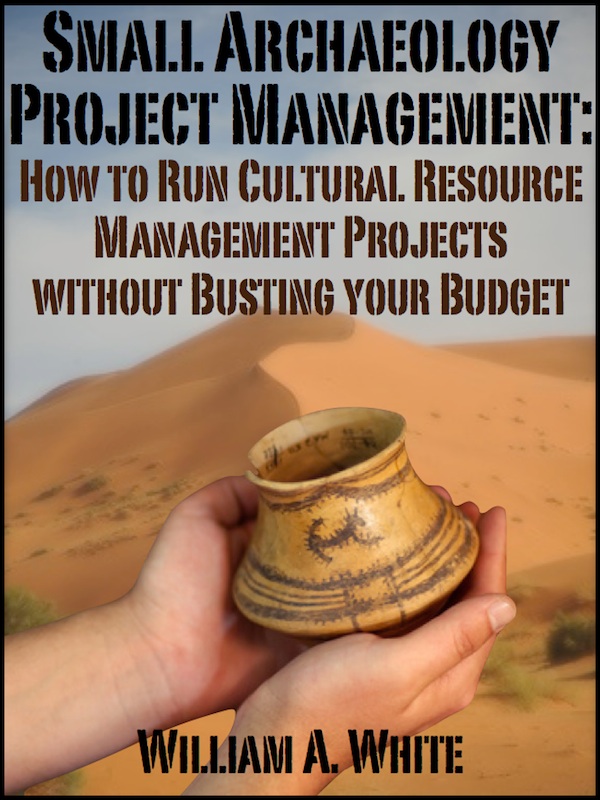
Small Archaeology Project Management is now on the Kindle Store. Over 300 copies were sold in the first month! Click Here and see what the buzz is all about.
Join the Succinct Research email list and receive additional information on the CRM and heritage conservation field.
Get killer information about the CRM archaeology industry and historic preservation.